

September 17, 2026
Does an Author Actually Need Social Media to Sell Books?
We’re about to say something that might divide the room—grab a seat. At some point — and nobody can pinpoint exactly when — being an author quietly became a second career in content creation.
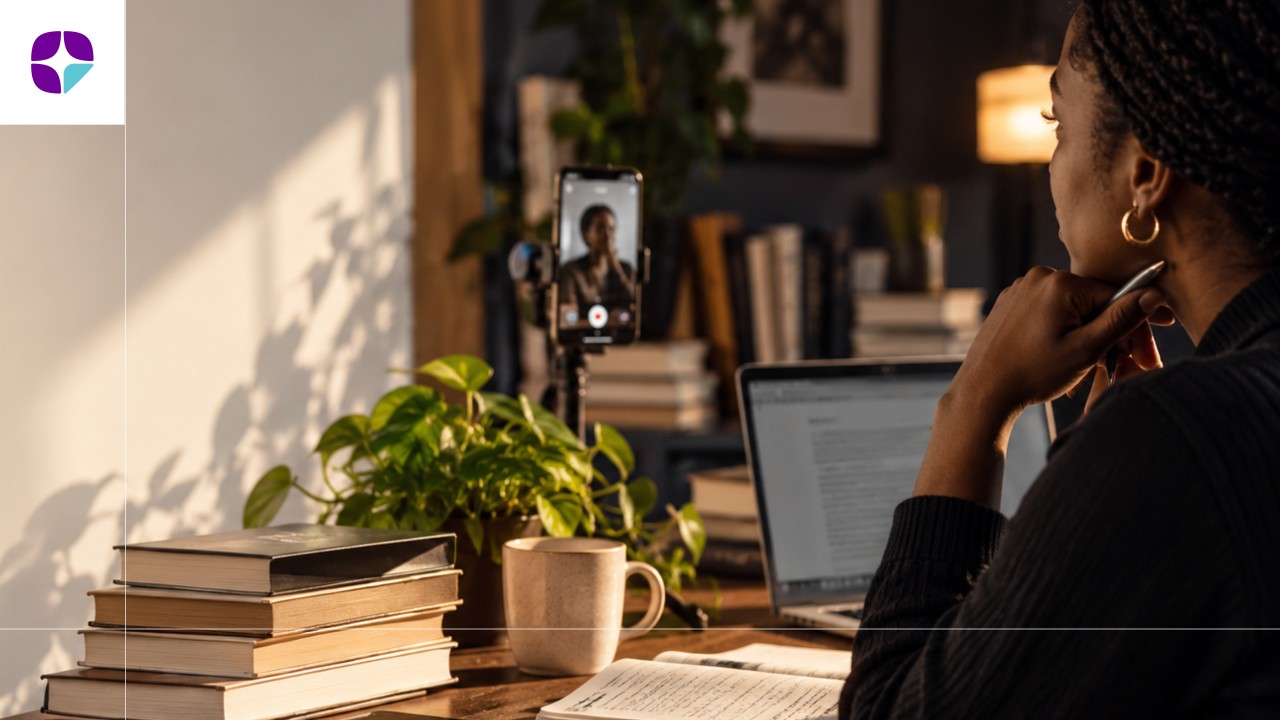
We’re about to say something that might divide the room—grab a seat.
At some point — and nobody can pinpoint exactly when — being an author quietly became a second career in content creation.
Write the book. Build your Instagram. Start a TikTok. Post consistently. Grow your following. Create Reels that stop the scroll. Build a personal brand. Engage your audience. Go live. Respond to comments. Then somehow, in between all of that — find the time and the mental space to write the next book.
If you have ever felt exhausted just reading that list, you are not alone. And if you have ever wondered whether all of that is actually necessary — whether the authors who are succeeding are really succeeding because of their social media presence, or whether they are succeeding in spite of how little time they have left after maintaining it, that is the question we are sitting with this week.
Because the honest answer is more complicated than anyone is telling you or making it seem. And the publishing industry, which benefits from authors building their own audiences for free, is not exactly incentivized to complicate it.
First, the part where social media genuinely, undeniably works
Let us not pretend this is a neutral conversation. The evidence that social media can sell books — in the right circumstances, for the right book, on the right platform — is overwhelming. And the story that makes this clearest is one that the entire publishing world has been studying for five years now.
In 2016, Colleen Hoover, an American author published It Ends with Us — a novel about the brutal reality of being in an abusive relationship. It sold around 36,000 print copies in its first year and hit the New York Times bestseller list briefly before fading. By most industry measures, it had had its moment.
Then, in late 2020, something happened on TikTok. Readers — mostly young women — started posting videos of themselves finishing the book. Tearful, raw, unscripted videos with titles like "this book destroyed me" and "I cannot stop crying." Nobody commissioned those videos. Nobody paid for them. They were just readers, in their bedrooms, processing something that had genuinely moved them.
The #ColleenHoover hashtag grew to over 2.4 billion views on TikTok. It Ends with Us has since sold over 10 million copies worldwide and spent 169 weeks on the bestseller list — four years after its original publication. It was eventually adapted into a film that grossed over $300 million at the global box office.
That is not actual marketing. That is a cultural moment. And it was born entirely on social media, entirely organically, by readers who could not stop talking about a book that had already been quietly sitting on shelves for four years.
This is what social media can do when it works. It does not just inform readers that a book exists. It creates the kind of emotional, peer-to-peer recommendation that no advertising or marketing budget may try to manufacture — and that no author can entirely control or predict.
Now, the part where the conversation gets more honest
Here is what the Colleen Hoover story does not tell you, and what the publishing conversation around social media almost never addresses.
Colleen Hoover did not go viral because she posted consistently. She went viral because a seventeen-year-old named Eloise Hampson recorded herself crying over a book and posted it to her own page. Hoover was not in that video. She did not create it. She did not engineer it. It happened because the book was emotionally resonant enough to produce that reaction — and the platform happened to be the right place for that reaction to spread.
While no single video can take 100% of the credit for an entire author's career, the specific video by 17-year-old Eloise Hampson is widely documented by major media as a primary spark that ignited the global Colleen Hoover. In other words: the book made the content. Not the other way around.
This distinction matters enormously, because the lesson the publishing industry extracted from Hoover's story — "authors need to be on social media" — is not quite the right lesson. The right lesson is closer to: books that produce strong emotional responses travel fast on platforms designed for emotional content. Whether the author posts reels has very little to do with it.
Elena Ferrante has been publishing novels since 1992. She has no author photo. No one knows her real name. She has refused in-person interviews, bookstore readings, lectures, television appearances, and award banquets for her entire career. She once wrote to her publisher:
"I believe that books, once they are written, have no need of their authors."
Her Neapolitan Novels have sold hundreds of thousands of copies in the United States alone and made Time magazine's list of the 100 most influential people in 2016. She has never posted a single Reel.
Donna Tartt — Pulitzer Prize-winning author of The Goldfinch and The Secret History — is famously not on social media. The Secret History has been in print for over thirty years and is still being discovered by new readers through word-of-mouth, bookshop recommendations, and the kind of quiet, accumulating reputation that no algorithm can replicate.
These are not obscure examples. They are two of the most celebrated literary fiction authors alive today. Neither of them has a TikTok, BookTok, or any major social media presence.
A Nigerian example worth sitting with
I first heard about Temilade Salami's book—Read This If You're In Your 20s because I saw her talking about it on Instagram.
That sentence is worth pausing on — because it is a completely honest description of how discovery works in the modern publishing ecosystem. I was not browsing a bookshop. I was not following a recommendation from a literary magazine. I was scrolling, and I stopped, because someone was speaking about something that felt relevant to my life and 99 others.
Temilade Salami, known online as Global Temi, is a Nigerian author and climate advocate who has built a visible personal brand around youth development, global engagement, and storytelling. Her Instagram presence — reels, posts, event coverage, in-person launches — functions as part of a broader author platform that includes a physical bookstore in Abuja, speaking engagements, and content that consistently reaches the audience her books were written for.
Her case supports the argument that social media can be a powerful route to discoverability — particularly when the content is genuinely aligned with the book's themes, consistently produced, and connected to offline touchpoints that convert attention into purchases. A reel that makes someone stop and listen is not the same as a sale. But it is the beginning of a relationship that can become one.
What it does not prove is that social media is a universal requirement. What it actually shows is something more nuanced: that when an author's existing content and the book they are promoting speak to the same audience in the same language, social media becomes a very powerful channel. When those things are misaligned, it becomes a very expensive way to spend time that could have been spent writing.
What the data actually says about how readers discover books
The conversation about social media and books tends to be driven by the most dramatic cases — the viral moments, the BookTok explosions, the author who woke up famous because of a stranger's video. Those cases are real. They are also exceptional.
According to Written Word Media's 2026 Reader Survey of nearly 3,600 engaged readers, the top book discovery channels are: Amazon at 68%, email newsletters at 64%, Goodreads at 46%, friends and family at 45%, and social media — including Facebook, Instagram, TikTok, and influencers — at 42%.
Read that again. Email newsletters outperform social media as a book discovery channel — by 22 percentage points. Amazon, which operates through its own recommendation algorithm driven by sales velocity and metadata, beats them both. And friends and family — the oldest, least glamorous, entirely offline form of word-of-mouth — sits right alongside social media at 45%.
The picture this data paints is not the one the publishing conversation usually presents. Readers are not discovering books primarily through Instagram. They are discovering books through a portfolio of channels — retail, email, community, and yes, social — none of which dominates alone.
And here is the statistic that should make every author who has spent hours agonising over their posting schedule sit back and breathe: only 2% of readers follow authors on TikTok. Meanwhile, 49% subscribe to author email newsletters.
Your newsletter — the one you could write once a week in the equivalent time it takes to plan, film, edit, and post one reel — reaches more of your readers than your social media does. That is not an argument against social media. It is an argument for understanding which tool serves your specific audience before deciding which one deserves your limited time.
The part where genre changes everything
One of the most important things missing from the "every author needs social media" conversation is the word that should precede "every author": which?
Because the relationship between social media and book sales is not uniform across genres. It is deeply, structurally different depending on what kind of book you are writing and who you are writing it for.
Romance, romantasy, young adult, and emotionally driven fiction thrive on BookTok. These are genres where the emotional experience of reading — the gut punch, the love interest, the ending that makes you cry — translates directly into short-form video content. When a reader finishes It Ends with Us and needs to tell someone about it immediately, TikTok is the perfect place for that reaction. The genre and the platform are speaking the same emotional language.
Literary fiction travels differently. It relies on reviews, prizes, bookshop hand-selling, and the slow accumulation of critical reputation. The authors who succeed in this space — Ferrante, Tartt, Cormac McCarthy — often have little to no personal social presence. The work carries itself because the readers it is aimed at discover books in completely different ways.
Prescriptive nonfiction — business, self-help, career, finance — depends most on the author's professional credibility and existing community in their field. A business book author who speaks at industry conferences, publishes in respected trade publications, and has a well-maintained email list of professionals in their niche does not need a single TikTok. Their readers are not on BookTok. They are in conference rooms, LinkedIn, professional associations and on the podcast apps they use during their commute.
Children's books travel through parents, teachers, librarians, and school visits. Academic and professional books live or die by conference adoption, course syllabuses, and professional community recommendation. Christian and faith-based books spread through church networks, faith-based media, and pastoral recommendation.
The question is never "should I be on social media?" The question is always: where does my reader actually discover books? And is that where I am spending my time?
So does an author actually need social media?
Here is the honest, unsatisfying, but entirely accurate answer: it depends.
It depends on your genre. It depends on your reader. It depends on what you are trying to achieve and over what timeline. It depends on whether you have the capacity to create content that genuinely serves your audience — or whether you are creating content because you feel you are supposed to.
What the evidence consistently shows is this: social media is a high-potential channel that can dramatically accelerate discoverability when the book, the genre, the platform, and the author's strengths are aligned. When they are not aligned — when a literary fiction author forces themselves onto TikTok, or when a business author chases Instagram followers instead of building their email list — it is a drain on the energy that should be going into the work itself.
The authors who use social media well do not use it because they were told to. They use it because they genuinely connect with people on those platforms, because the content they create is an authentic extension of what the book is about, and because the platform reaches the exact people who would love what they have written.
Everyone else has options. Email newsletters that outperform social media in book discovery. Podcast appearances that put the author in front of exactly the right niche audience. Speaking engagements that build the kind of trust no reel can replicate. Bookshop relationships that put the book into the hands of readers who are already there, already buying. Word-of-mouth from readers who loved the book — which, according to every study on the subject, remains the single most powerful driver of book sales anywhere in the world.
Social media is one shelf in the library of discoverability. A well-stocked library has many shelves. And the authors who build careers — not just launches, not just viral moments, but actual, sustained, multi-book careers — tend to be the ones who understand all the shelves, and choose the ones that actually carry their work and suit their genre.
From Clasier
We have worked with enough authors to know that the social media conversation is one of the most anxiety-inducing in publishing. It produces a particular kind of guilt — the sense that if you are not posting, you are failing. That if you are not building a following, you are falling behind. That the book you are writing is somehow already at a disadvantage because you have not started your TikTok yet.
We do not believe that. And the evidence does not support it.
What we do believe is that every author — every single one — deserves a discoverability strategy that is built around their book, their genre, their reader, and their actual capacity. Not around what worked for someone else. Not around a general feeling that social media is where everyone is. Around an honest understanding of where your specific reader actually goes to find their next book.
That strategy might include social media prominently. It might barely include it at all. The only wrong answer is the one that is not built on that honest understanding.
Now we want to hear from you.
We have made our argument. Now we are genuinely curious about yours.
Have you bought a book because of something you saw on social media? Or has a book found you in a completely different way — a conversation, a bookshop, an email, a friend who would not stop talking about it?
Are you an author who has built something real through social media — or one who has tried and found it exhausting and ineffective? Are you someone who refuses to be on social platforms entirely and has found other ways to reach readers?
Drop your answer, your experience, or your disagreement in the comments. Tell us where your best book discovery has come from. Tell us if we are wrong. Tell us if we are right. Tell us the thing you think about this that nobody is saying out loud.
Because this is not a conversation that has a clean ending. And we would rather have it honestly — with you — than pretend it does.