

August 20, 2026
The Editing Myth
Why Your Book Needs More Than a Grammar Check “I’ve already edited my manuscript.” It’s one of the most common things we hear from authors after being told their book needs editing — and they’re usually not wrong.
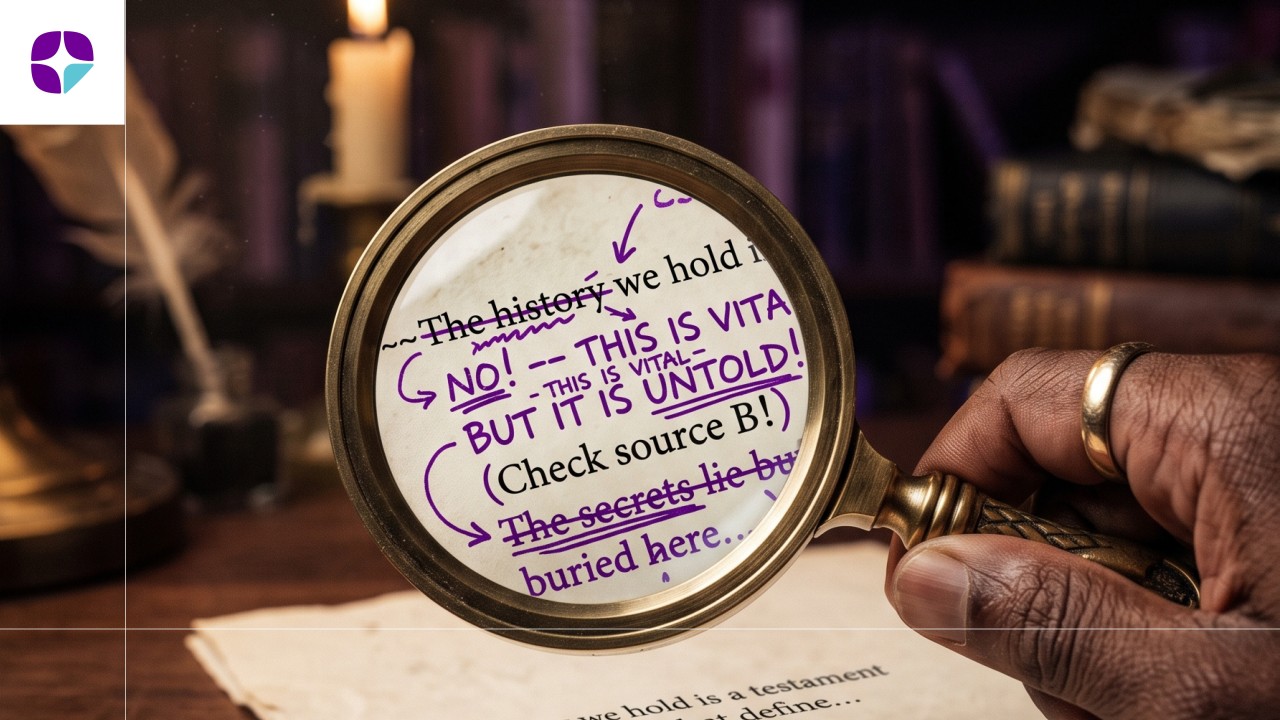
Why Your Book Needs More Than a Grammar Check
“I’ve already edited my manuscript.”
It’s one of the most common things we hear from authors after being told their book needs editing — and they’re usually not wrong. They’ve read it several times. Fixed the typos. Rewritten sentences that bothered them. That’s genuine work.
But it’s also only a fraction of what “editing” actually means. In publishing, the word covers several distinct stages of preparing a manuscript, each answering a different question, each requiring a different skill. Understanding the difference is often the first step toward a book that’s genuinely ready — not just one that’s been read carefully by its own author.
Let’s examine the different modes
1. Developmental Editing — Does the book work?
This is the earliest and broadest stage, and it usually happens before any fine-tuning of language begins. A developmental editor is looking at the architecture of the book as a whole:
• Structure and chapter organisation
• Whether the argument (or story) builds logically
• Pacing and flow
• Gaps, repetition, or ideas that never get fully developed
• Whether the book actually delivers on the promise it makes to the reader
At this stage, a beautifully written paragraph in the wrong place is still a problem. Developmental editing can mean reordering chapters, cutting sections an author is attached to, or asking for entirely new material — because no amount of clean grammar fixes a book that doesn’t hold together.
Before worrying about whether a sentence has a comma in the right place, someone needs to ask whether the book itself works. That is the territory of developmental editing.
A developmental editor looks at the bigger picture: the structure, argument, chapter progression, gaps, repetition, pacing and whether the book delivers on what it promises its reader.
Imagine you've written a leadership book and made your strongest argument in Chapter 10. A developmental editor might ask:
Why are we waiting until Chapter 10 to get here?
They might recommend moving sections, restructuring chapters, developing an idea further or cutting material that is repeating something the reader already understands.
The goal isn't to make the sentences prettier. It is to make the book stronger.
2. Line Editing — Does the writing work?
Once the structure is sound, line editing turns to how the ideas are actually communicated, sentence by sentence:
• Voice and tone
• Clarity and rhythm
• Word choice
• Awkward or confusing passages
• Unnecessary repetition
This is a delicate stage. The goal isn’t to smoothen a manuscript into something generic — it’s to sharpen the writing without changing the author’s fundamental voice or message. A good line editor should make an author sound more like themselves, not less.
Once the larger structure is working, attention can move closer to the sentence. This is where line editing comes in. A line editor looks at how you are communicating your ideas.
Imagine an author has written:
“In light of the aforementioned circumstances, it is important to note that organisations should, where possible, endeavour to…”
Nothing is necessarily grammatically wrong with that sentence, but it could probably say what it needs to say much more clearly. Line editing helps remove that kind of friction.
It isn't about making every author sound the same. It is about helping the author's voice come through more clearly.
3. Copyediting: Is the Writing Correct and Consistent?
Now we get closer to the part most people associate with editing. Copyediting deals with correctness, consistency and clarity at the language level.
It is probably the stage most people picture when they hear the word “editing” — but it’s only one part of the process:
• Grammar, spelling, and punctuation
• Syntax and capitalisation
• Consistency and style conventions
• Factual or internal inconsistencies worth flagging
It matters enormously. But notice it comes third — after the bigger structural and voice-level questions have already been settled. A manuscript can be grammatically flawless and still fail at the earlier stages.
A copyeditor might notice that you've used organisation throughout the book but suddenly switch to organization halfway through. Or perhaps a person's name is spelled three different ways.
Or a chapter refers to an event happening in 2019 in one place and 2020 somewhere else. These are the details that can quietly undermine an otherwise excellent book. The copyeditor's job is to catch them.
But there is an important distinction:
Copyediting is not developmental editing.
The copyeditor is not there to decide whether Chapter 8 should exist. They're making sure the book you've decided to write is correct and consistent on the page.
4. Proofreading: Is the Final Book Clean?
This is the last check, usually done after the book has been typeset and designed. A proofreader is looking for:
• Typographical errors
• Missing words
• Formatting inconsistencies
• Page-number issues
• Heading and caption errors
• Spacing problems introduced during typesetting
It’s worth being precise about what a proofreader is not doing: rebuilding the book. By this point, the book is finished. Their job is to catch what shouldn’t be there in the final copy — nothing more, nothing less.
Proofreading is generally performed on the designed or typeset pages—the version that is much closer to what the reader will actually see.
Why?
Because new errors can appear during the production process.
A word might disappear. A page number might be wrong. A heading might be formatted differently from the others. A line might break awkwardly. A quotation might be cut off.
These are not necessarily manuscript problems. They are final-production problems.
The proofreader's job is to catch them before the book reaches the reader. Think of proofreading as the final sweep before the doors open.
One Manuscript. Four Different Lenses
It would be tidy to present these as four completely separate boxes. In practice, they’re not always so clean. There’s overlap between stages, and terminology isn’t used identically across every publisher, editor, or market — what one house calls a line edit, another might fold into copyediting.
Here's a simple way to see the distinction.
Imagine you've written a chapter about resilient hiring for a leadership book.
The developmental editor notices that the chapter contradicts an argument you made earlier and suggests restructuring the section.
The line editor notices that you've used the phrase “build organisational resilience” six times in two pages and helps the prose become more natural.
The copyeditor notices that you've used organisation in one paragraph and organization in another and ensures the style is consistent.
Then, after the book has been designed, the proofreader spots a missing word in the final PDF.
Same book. Same chapter. Four different questions.
And that is why saying “I've already edited it” doesn't always tell a publisher very much.
But Are These Four Completely Separate?
Not necessarily.
This is where publishing terminology gets interesting.
Different publishers, editors and markets use these terms somewhat differently. Some professionals combine line editing and copyediting. Some use terms such as substantive editing or structural editing for work that overlaps with developmental editing.
And one editor may perform several functions, particularly on smaller projects. So don't become overly attached to the labels.
What matters is understanding what work your manuscript actually needs. A book may have beautiful prose but a weak structure. It may have an excellent structure but an unclear writing. It may be beautifully written and well structured but contain inconsistencies.
And even a thoroughly edited manuscript can still develop a typo during typesetting. Different problems require different kinds of attention.
From Clasier
Authors spend months and sometimes years putting their ideas onto the page. Editing is what gives those ideas another chance to become what the author intended them to be.
It is not about taking the author's voice away. It is not about making every book sound polished in exactly the same way. And it certainly isn't just about hunting for misplaced commas.
Sometimes editing means asking a difficult question about the entire structure of a book. Sometimes it means rewriting one sentence so the idea finally lands. Sometimes it means catching a tiny inconsistency that would otherwise distract the reader.
And sometimes it means finding one last error on page 247 before anyone else does.
Good editing meets the book where it is and helps it become what it needs to be. Because the goal isn't simply to publish a manuscript without mistakes. The goal is to give the reader the clearest, strongest version of the author's ideas.
The distinction worth remembering
If there’s one thing worth carrying away from this, it’s not a checklist. It’s a set of questions:
Does the book work? Does the writing work? Is this correct? Is the final copy clean?
Four different questions. Four different kinds of attention. And an author who has only answered the third one has done real work — they just haven’t finished asking all the questions their reader will eventually ask them.
That’s the myth worth retiring.