

August 13, 2026
The Four Codes Behind Your Book: ISBN, CIP, Barcode and Copyright
What Every Author Should Know Before Publishing Their Book This may not be the most exciting part of publishing a book. But it is one of the parts you should understand.
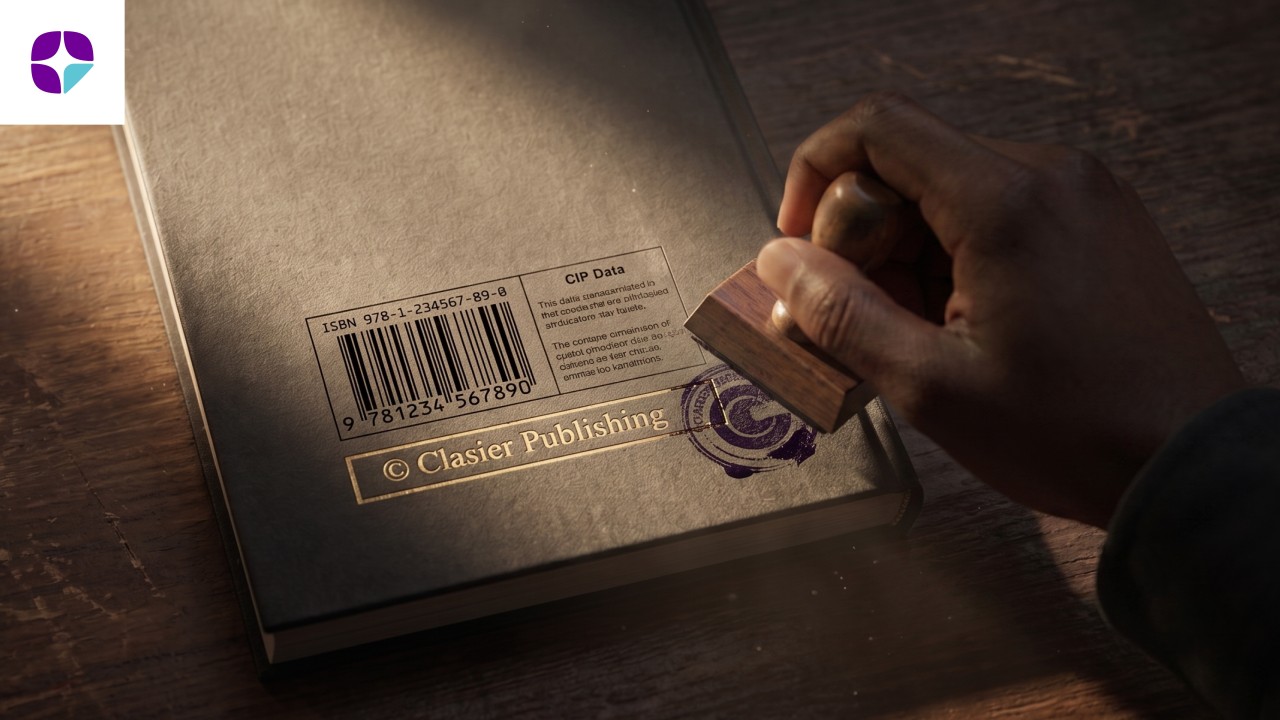
What Every Author Should Know Before Publishing Their Book
This may not be the most exciting part of publishing a book. But it is one of the parts you should understand. Because behind the numbers, lines and fine print are four things determining how your book is identified, catalogued, sold and protected.
Imagine holding your book for the first time. The cover is finally printed. Your name is on it. The pages you spent months—perhaps years—writing are now bound between two covers.
Then you notice the small details;
A string of numbers on the copyright page. A block of technical-looking information underneath it. A series of black lines and numbers on the back cover. And somewhere inside, a copyright notice bearing your name.
To most readers, these details are easy to overlook. To the publishing industry, they are doing important work.
And to you, the author, understanding what they mean can save you from a surprisingly common mistake: assuming that ISBN, CIP, barcode and copyright are four different versions of the same thing.
They are not.
Each serves a different purpose. One identifies your book. One helps libraries catalogue it. One allows machines to recognise it in commercial systems. And one protects the original creative work behind it.
So, before your next manuscript becomes a finished book, let's take a closer look at the four things hiding in plain sight.
1. ISBN: Your Book's Identity
The International Standard Book Number, or ISBN, is probably the number authors encounter most often.
An ISBN is a unique identifier assigned to a particular publication or edition of a book. It helps publishers, booksellers, distributors, libraries and other constituents of the book trade identify exactly which publication they are dealing with.
Think of it as your book's identity number.
And there is an important detail here: different formats generally require different ISBNs. If your book is available as a paperback, hardcover and ebook, those formats are treated as separate products for ISBN purposes.
Why?
Because a bookseller needs to know exactly what is being ordered, stocked, sold or catalogued.
In Nigeria, ISBNs are issued through the National Library of Nigeria, which is the country's ISBN agency. But there is a misconception worth clearing up immediately:
An ISBN does not give you copyright. It does not establish ownership of your manuscript. It does not prevent someone from copying your work. It does not replace copyright protection. It simply identifies the publication.
That distinction matters.
2. CIP: The Information Libraries Need
Then there is CIP—Cataloguing-in-Publication data.
This is the block of bibliographic information that often appears on the copyright page of a published book. It can look intimidating to a reader because it is designed less for the casual reader and more for the people and systems responsible for organising books.
Its purpose is relatively simple: to provide standardised information that helps libraries catalogue a book.
Author. Title. Subject information. Classification details. Publication information.
In other words, while the ISBN helps identify the publication, CIP helps describe and organise it within a library system.
That distinction becomes particularly useful when you think about the life of a book beyond its launch. A book isn't only something that sits on a retailer's shelf. It can become part of a school library, a university collection, a research database, or an institutional archive.
CIP helps that book fit into those systems.
For authors publishing in Nigeria, the National Library of Nigeria is the relevant institution for CIP services. Authors and publishers should confirm the current requirements and process directly with the National Library, particularly because procedures can change.
And one important clarification:
CIP is not copyright registration.
It does not establish ownership of your work. It is mainly bibliographic information designed to support cataloguing.
3. The Barcode: When Your Book Speaks to a Scanner
You've probably seen it hundreds of times without thinking about it. Those familiar black lines on the back of a book.
That's the barcode.
A book barcode allows the ISBN to be represented in a machine-readable format, commonly using the EAN-13 standard. It allows retail and inventory systems to scan the publication rather than requiring someone to manually enter its identifying number.
In simple terms: The ISBN tells the system what the book is. The barcode helps the system read that information quickly.
This is why ISBN and barcode are closely related, but they are not the same thing. The ISBN is the identifier. The barcode is the visual representation that allows scanners to read that identifier. And because the barcode is generally placed on the back cover, authors sometimes assume it is another form of registration or protection.
It isn't. It is primarily a commercial and logistical tool.
This is also why getting the correct ISBN into the barcode matters. A beautiful cover with a barcode that points to the wrong number can create unnecessary problems in distribution and retail systems.
The lesson?
Don't treat the barcode as just another graphic element your designer drops onto the back cover at the last minute. It carries vital information. In fact, standard bookstores will not stock your book if the barcode is absent, incorrect, or too small for their sales scanner to capture.
4. Copyright: The One That Protects the Work
Now we get to the part that authors most often confuse with the other three.
Copyright is fundamentally different.
Your ISBN identifies your publication. Your CIP helps libraries catalogue it. Your barcode helps commercial systems read it.
Copyright concerns the creative work itself.
Under Nigeria's Copyright Act 2022, copyright protection does not depend on completing a registration formality. In other words, an author does not have to obtain a copyright registration certificate before copyright can arise in an original work that qualifies for protection.
That is important. But it raises another question:
If copyright is automatic, why would anyone register a work?
The Nigerian Copyright Commission provides a voluntary copyright registration system. Registration does not create the copyright in the first place, but documentation of the work and registration can provide useful evidence in the event that ownership or authorship is later disputed.
That distinction is crucial. In other words, registration is not what makes you the copyright owner. Rather, it can help create an official record that may be useful when establishing your claim. And for an author who has spent years developing a manuscript, that distinction is worth understanding.
The Mistake That Brings Them All Together
Imagine an author saying: "My book is protected because it has an ISBN."
It sounds valid. But it isn't.
An ISBN does not protect your intellectual property. A barcode does not protect your intellectual property. CIP does not protect your intellectual property. They each perform a different function.
A useful way to remember it is this:
ISBN: What publication is this?
CIP: How should a library catalogue it?
Barcode: How can a commercial system read it?
Copyright: What rights exist in the creative work?
Four different questions. Four different functions. One book.
Why Authors Should Care
It is easy to dismiss these things as administrative details. After all, most readers aren't buying a book because they are excited about its ISBN.
But publishing is an ecosystem.
A book has to be identifiable, catalogued, move through commercial systems, and the creative work behind it needs legal protection.
Understanding these pieces also changes the way an author thinks about their book. You begin to see that publishing isn't simply Write → Print → Sell.
There is an entire infrastructure underneath the finished product, and knowing how that infrastructure works makes you a more informed participant in your own publishing journey.
Before Your Book Goes to Print
Before approving your first or next book for publication, don't just ask whether the cover looks good and whether the pages are properly formatted.
Ask:
Do I have the appropriate ISBN for each format of the book?
Has the CIP information been properly obtained and placed where applicable?
Does the barcode correspond correctly to the ISBN?
Do I understand what copyright protects and what it does not?
And perhaps most importantly:
Do I know which of these processes my publisher is handling on my behalf?
You should. Because when you understand what is being done to your book—and why—you are in a much better position to make informed decisions about it.
From Clasier
A book may begin as an idea in an author's head, but by the time it reaches a reader's hand, it has become something much more complex.
It has an identity. It has a place in the publishing ecosystem: systems that help people find, catalogue, distribute and sell it.
And behind all of that is an original work that belongs to someone. The numbers and codes may look small on the page, but they tell a much bigger story about what happens when an idea becomes a book.
At Clasier, we believe authors deserve to understand that story—not just the part that happens when the book is finally printed. Because publishing isn't simply about putting your name on a cover.
It's about understanding what you're putting into the world, and making sure it is properly identified, documented, positioned for sales, and protected along the way.